Most women's movements revolved around women's issues and rights,
and these movements tended to shy away from political issues unless these
movements focus solely on women. The "Women Strike for Peace"
movement, or WSP, consisted of women with enough courage to take women's
movements to the next level, and target larger, more global political issues.
These women challenged issues that "ordinary housewives" wouldn't
DARE touch! They touched upon important issues such as the nuclear arms race,
military spending, and proper benefits for our troops. Why was the WSP
ultimately successful? And would their tactics be applicable to today's
society? Or would they flop under the weight of our government's new and
improved policy towards social movements and strikes?
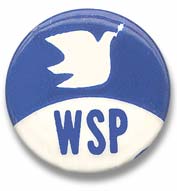
In the book
"Women Strike for Peace" by Amy Swerdlow, the most shocking element
of the WSP is made clearer: they were entirely structure-less. There
was no centralized state where they resided, nor was their an appointed leader
to pin the movement on. While this seems absolutely absurd at first glance,
there is actually various benefits that were pulled from this new approach to
women's movements. Firstly, the media LOVES to use scapegoats, and dig up
dirt on them to create controversy. The WSP had no true leader to use as a
scapegoat, so in order for people to dig up dirt on the WSP, they had to assume
and generalize, which is a much less efficient tactic. The only
"leadership" per-say was the women that helped fund the WSP's events
and advertisements. This rebellious idea of no central leadership could be
derived from their view that so-called "experts" in society are the
same people that brought our country to the brink of disaster, so their advice
could not be trusted. Hence they had to challenge the very system society had
built. While the WSP had many problems arise from their unorganized group
having a lack of effective communication, it still proved successful via the
element of surprise. This was a tactic that was never truly used before by a
social movement, as practically every one before it had some sort of
leadership. The WSP took advantage of this and proved to become a very
successful movement. Amy Swerdlow writes
that women of many different political backgrounds were a necessity: “The organization
of the antitesting campaign used the talents of women of many different
political perspectives. Some were interested only in pure milk for their
children, others saw a test ban treaty as a way of lessening Cold War tensions,
and still others saw it as a step in the long journey toward total disarmament
and world government” (Swerlow pg81). These women of varying perspectives banded together because while they have different views and goals in mind, they realized that these goals could not be achieved alone, and that the WSP may just be the rising organization they need to make a difference.
Another
reason that having no centralized leadership gave them an advantage is that
women of many different perspectives and political perspectives began to slowly
join their ranks, making the WSP a more broad-minded group, open to more and
more ideas, then looking through these ideas and picking out the best looking
one. The diversity of the group made it less intimidating to others, making
them more inclined to join the WSP. It’s odd how the refusal to appoint a
leader benefitted them so much, considering how illogical it all sounds on
paper.
WSP was so successful due to how broad-minded it was. It gave power to the individual, the "ordinary housewife", to fight back against warmongers and nuclear testing, as well as other political issues. The group mentality gave these women the courage to face many difficult times, but they remained steadfast. The vast majority of it's members were very proud to be a part of it, which is clear to me during the WSP's anti-HUAC statement: "Approximately one hundred women volunteered to testify before HUAC and were refused. Carl Urner of Portland, Oregon, spoke for many of those who volunteered. She made it clear that she would not 'name names.' 'I think each woman should be--and probably is--proud of her own participation'"(Swerdlow pg105).

Unfortunately, in today's
society the tactics of the WSP would prove largely unsuccessful. The element of
surprise, for one, is now gone. As the saying goes: Fool me once, shame on you,
fool me twice, shame on me. The government's control of social media and media
attention in general makes it more difficult for social movements to thrive. For
example, the Occupy Wallstreet movement that was quite popular when it first
began, but as soon as the media caught notice of it, they began looking for a
leader to use as a representative for the movement. When they realized the
movement had no leader, they became rather uninterested in the movement and
Occupy Wallstreet (Link here: http://occupywallst.org/
) received a lot less attention from
the media. The government of today is much more capable of ignoring movements,
since people are now more expendable, since there is almost always somebody
unemployed or poor that is ready to take their job, or position. Why should
they care about the state of the economy or social issues when their pockets
are overflowing with profits and paycheck bonuses? So it begs the question: what new tactics must we bring to the "table" of political issues, in order to bring about necessary change to achieve peace in our country? No, we should set our goals higher, we must achieve peace in our world!

Bro, listen. The thirty nine steps are real! My name is Richard Hannay and I am involved in a conspiracy that threatens to make the United Kingdom, well, pardon my analogy, but, if the UK was a treadmill, then The Conspiracy would be a yoga ball that some asshole wedged into it and made it eat it, spit said Yoga ball out, and then promptly commit suicide.
ReplyDelete